Stratospheric observatory for infrared astronomy
Best match
Newest
The Dryden Aircraft Operations Facility in Pa.. | Free public domain photo - 440766
By www.rawpixel.com
Earth at night | Free public domain photo - 440239
By www.rawpixel.com
Logos of NASA and the German Aerospace Center.. | Free public domain photo - 440735
By www.rawpixel.com
The constellation of Vulpecula. Original from.. | Free public domain photo - 441179
By www.rawpixel.com
NASA's Boeing 747SP SOFIA airborne observ.. | Free public domain photo - 440759
By www.rawpixel.com
NASA's SOFIA airborne observatory lands a.. | Free public domain photo - 440004
By www.rawpixel.com
The cavernous expanse of the Dryden Aircraft .. | Free public domain photo - 440772
By www.rawpixel.com
Commercial airplane | Free public domain photo - 440752
By www.rawpixel.com
NASA's SOFIA | Free public domain photo - 418592
By www.rawpixel.com
NASA'S SOFIA | Free public domain photo - 440009
By www.rawpixel.com
Mission aircraft | Free public domain photo - 440005
By www.rawpixel.com
The heart of the NASA Center for Climate Simu.. | Free public domain photo - 440279
By www.rawpixel.com
Commercial airplane | Free public domain photo - 441104
By www.rawpixel.com
Cornell University, Infrared Interferometer m.. | Free public domain photo - 440063
By www.rawpixel.com
Two large science aircraft, a DC-8 flying lab.. | Free public domain photo - 440043
By www.rawpixel.com
Unsplash ID f-Y4Jjh9JCA
By unsplash.com
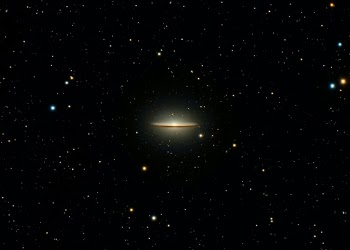
Discovered in 1781 by the French astronomer and comet hunter, Pierre Méchain, the Sombrero galaxy is a lenticular galaxy, which is a classification between full elliptical and spiral, meaning that it has a disc structure but without spiral arms. It’s about 31 million light years away in the constellation of Virgo and about 50 million light years across (one-third of the Milky Way’s diameter). Astronomers have determined that the supermassive black hole at the center of the galaxy is about 1 billion solar masses, making it one of the largest in nearby galaxies. They’ve also determined that there are between 1,200 and 2,000 globular clusters present, more than ten times the estimate for the Milky Way’s population, and they’ve been able to correlate the prevalence of globular clusters with the amount of bulge in the galaxy. Using infrared spectroscopy astronomers have also determined that the bulk of star formation occurs within the highly contrasted dust lane. This is 2:20 hours of exposure.
By unsplash.com
Next
Home
New files
About
Search tips
Privacy Policy
DMCA Policy
Copyright Policy
File Upload Policy
Terms of service
Refund and cancellation
Security
Contact
Sitemap
Bye