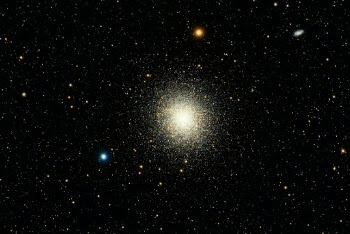
Messier 13 – the Great Globular Cluster in Hercules
Located in the armpit of the constellation Hercules, M13 is one of the best known globular clusters in the northern hemisphere. Discovered by Edmond Halley (for whom the comet is named) in 1714 and cataloged by Charles Messier in 1764, it’s a cluster of several hundred thousand closely grouped stars. The stars are about 100 times more densely packed than in our area of the galaxy. It’s estimated to be approximately 22.2 thousand light years away, with a diameter of 145 light years. The galaxy in the upper right is NGC 6207, which is about 30 million light years away and 34,000 light years across.
Globular clusters reside in the halo of a galaxy as opposed to the disk and are bound together by gravitational forces. There are about 150 known globular clusters in the Milky Way, with an estimated 20 more hidden by dust lanes. They are generally comprised of very old stars, and M13 is estimated to be 11.65 billion years old. The process in which globular clusters are created is largely unknown, but it’s hypothesized that they originate from areas of starburst activity and interactions between galaxies. There is no known active star formation in any of theses clusters, but due to the proximity of the stars collisions occur, and new stars are created. These new stars are called “blue stragglers”, some of which may be seen in the photo. The proximity of the stars (on average about one light year apart) also creates many binary star systems (think Tatooine), but due to the age and makeup of the stars there are very few with planets.
This is about 3:15 hours of exposure.
By unsplash.com